

HUMANMETRICS / INTEGRATED DELIVERY
Alliances fail socially before they fail contractually.
On major programs, the commercial and technical case gets tested hard. How the people will actually work together often doesn't, even though it decides how the next five or ten years go.
HOW WE HELP
HumanMetrics supports owners and alliances across the life of integrated delivery: choosing the right partner, setting the alliance up well, and keeping it working as one team when pressure rises.
Select well. Mobilise well. Deliver together.
Different employers. Different expertise. One shared result.
OWNERS AND ALLIANCES BRING US IN WHEN
- They're choosing a delivery partner and want evidence about behaviour, not just the bid.
- An alliance needs to behave as one team from the first week, not eighteen months in.
- A program is drifting because truth is travelling too slowly.
SELECT WELL
Choosing a delivery partner is a behavioural decision too.
We design and run behavioural assessment for integrated delivery procurement: alliances, delivery partners and collaborative contracts on major transport and infrastructure programs.
Shortlisted teams work through realistic delivery challenges, assessed against behavioural criteria agreed with you before the process starts. Your evaluation panel gets structured, defensible evidence about how they lead, listen, challenge and decide, alongside the commercial and technical scores.
On any procurement we assess, we work for the owner only. We don't advise bidders on the same process, so the evidence your panel gets stays independent.

MOBILISE WELL
Set the alliance up the way you'll need it to work.
Owner-team readiness before the partner arrives: shared expectations, clear decision rights, and how the owner will behave as a partner rather than only as a client.
Alliance establishment once it does: ways of working, the behaviours people commit to, and the conversations that are far easier to have before the first hard week than during it.

DELIVER TOGETHER
Making the difference reach the decision.
Alliances ask people from different employers, with different incentives, to act as one team. That only pays off if the difference actually reaches the decision.
We support alliance and delivery teams through leadership coaching across organisations, team development, program health checks and embedded behavioural advice.
You'll recognise the warning signs: governance theatre, badge loyalty, pre-cooked decisions, polite agreement in the room and resistance outside it, and bad news arriving too late to act on.
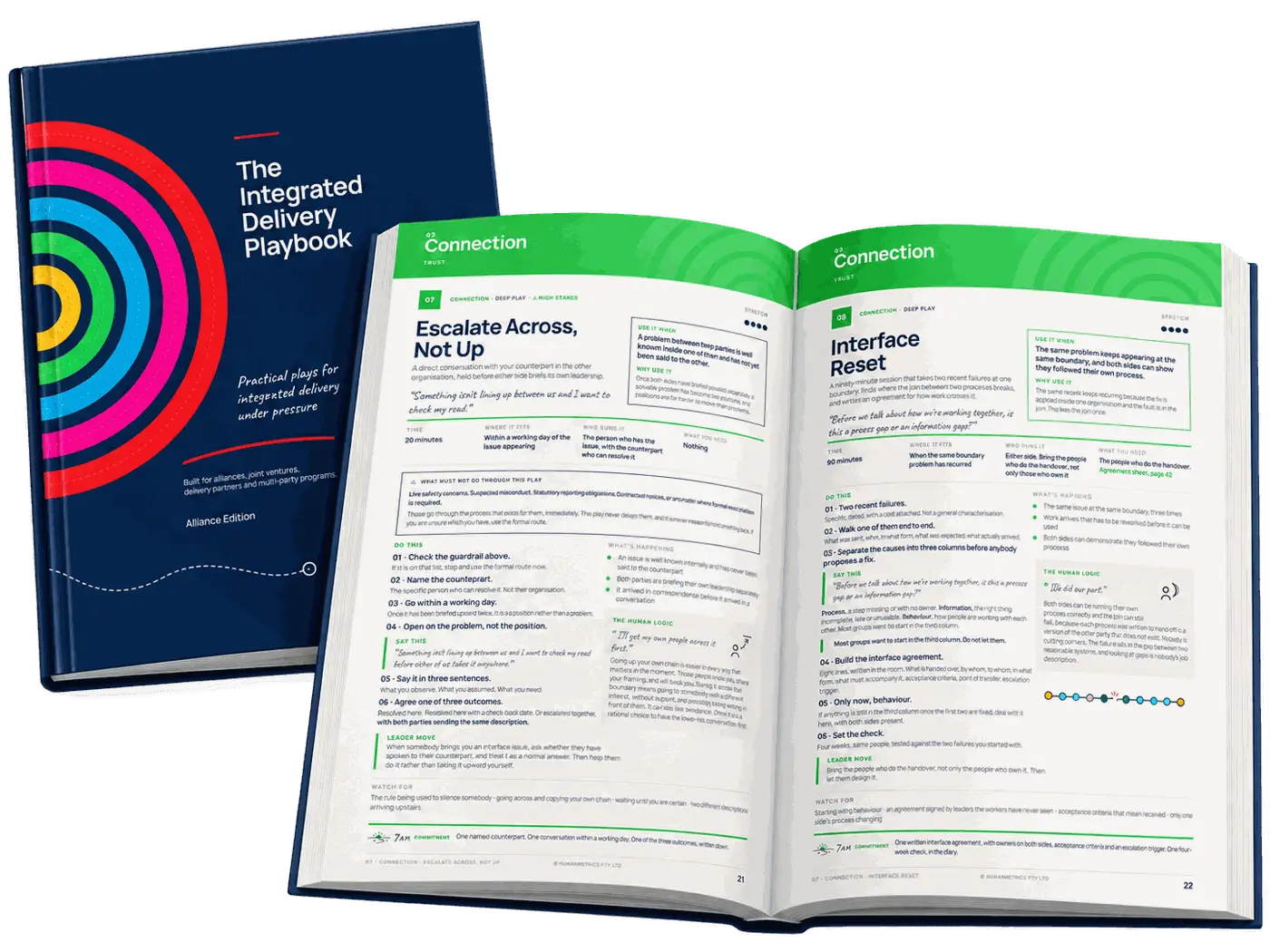
Our Integrated Delivery Playbook gives alliance leaders practical plays for mobilisation, handovers, escalation and the conversations in between.
PROGRAM HEALTH CHECK
Measure the joins, not just the teams.
On a major program, the expensive problems usually sit between scopes and between organisations. A decision nobody is sure they own. A handover where work keeps coming back. Expertise that arrives after the option is already narrowed. An issue settled in a side conversation instead of the forum built to decide it.
The Program Health Check measures how the program is actually working under pressure, as the people inside it experience it. It’s anonymous, short, and asked the same way every round, so results can be compared over the life of the program.
Then the findings go back to the leaders and teams who produced them. Together we agree where attention is needed, turn it into specific actions with clear owners, and measure again to see whether it's working.
The health check says what’s happening. The playbook says what to do about it.
QUESTIONS PEOPLE ASK
Is it anonymous?
Individual responses are never shared with your organisation. Results are reported at team level, and no small group is reported on its own.
Is it an audit or a psychosocial risk assessment?
No. It’s a development tool. It can support the governance and consultation work you already do.
WHERE WE'RE WORKING NOW
Brisbane 2032
HumanMetrics is currently working inside one of Queensland's major infrastructure environments, supporting leaders and owner teams as they shape multi-party work in the lead-up to Brisbane 2032.
The work focuses on the human dynamics that decide whether large programs succeed: how accountability travels across organisational boundaries, where decision rights become unclear, how quickly difficult issues surface, whether competing interests can be resolved in service of the whole, and what happens to collaboration when pressure rises.