

HUMANMETRICS · THE HUMAN SIDE OF COMPLEX WORK
Better performance when conditions are hardest.
Psychologist-led leadership development, team development and behavioural assessment for complex work.
Better performance for teams, leaders, alliances, boards and the meeting after the meeting.
WHAT WE DO
Leaders, teams and whole organisations. Often all three.
Sometimes the work starts with one leader. Sometimes with a team. Sometimes with several organisations trying to do something none could manage alone.
Psychologist-led25 years' experienceHogan and DISC accreditedClients include Transport and Main Roads, BHP, Sime Darby and Hastings Deering
A MORE INTERESTING WAY TO LOOK AT WORK
People are wonderfully capable. And occasionally quite hard to work with.
A room full of very intelligent people can spend an entire meeting misunderstanding one another, then leave feeling it went well.
None of this means you've hired the wrong people. Usually it means capable people are responding sensibly to what's around them. And what's around them can change.

We work with organisations developing already-capable people, as well as those working through difficult change or relationships. You don't need a crisis to have a good reason to call.
WHAT CLIENTS COME TO US FOR
It usually starts with a sentence like one of these.
Things we often hear, in one form or another.
- Our engagement scores are terrible, and I have no idea what to do.
- We have cliques and silos, and I don't know how to handle it.
- I'm a leader stuck in the middle. My team has no trust in leadership. What do I do?
- Our best technical people are moving into leadership. We want to set them up well.
- Several organisations need to deliver as one.
WHEN IT'S WORKING
What better performance looks like.
(Fewer meetings about the meeting is a nice side effect.)
Truth moves faster
Bad news reaches decisions while there's still time to act on it.
Expertise gets used
Relevant expertise shapes decisions, wherever it sits in the hierarchy.
Performance holds
The team spots problems earlier, adapts faster and keeps working well under pressure.
THE METRICS IN HUMANMETRICS
Every engagement starts with evidence.
Before we design anything, we ask the people doing the work. What it’s actually like, what’s getting in the way, and what they’d fix first. Then we build the work around their answers, and ask again later to see what’s shifted.
For teams, the evidence is their own feedback. For partner selection, structured observation. For individual leaders, profiles and feedback from the people they lead.
How it works
- Listen first. A short, confidential assessment. Everyone answers, not just the loudest.
- Work on what matters. Leader coaching and team sessions built on the results, not a standard package.
- Measure again. Same questions, so you can see what’s changed.
See what your team’s feedback can reveal How the Program Health Check works on major programs
Built on what your team actually says
People notice when a session is about them. Not a generic model or someone else’s case study, but their own results, their own priorities and the things they said needed fixing. That’s when the room leans in.
Everything was specifically aligned to our survey and key points to improve on.
WHY THE SPREAD MATTERS
Two teams. Same score. One of them is in trouble.
What Team A is telling you
People experience the team in much the same way. It’s middling for everyone. The work is lifting the whole team together, and everyone will feel the difference.
What Team B is telling you
Half the team thinks it’s going well. Half thinks it isn’t. The average of 5 describes nobody.
Many surveys stop at the average. We show the spread, because these two teams need completely different conversations. Treat Team B like Team A and you’ll spend the budget fixing the wrong thing.
A baseline, not a verdict.
PSYCHOLOGICAL SAFETY
Quiet teams aren't safe teams.
Silence costs people. Voice builds performance.
When people stay quiet
- Hazards stay hidden until someone gets hurt.
- Mistakes repeat, because nobody admits the first one.
- Good people burn out quietly, then leave.
- Boards believe things are fine while harm is happening.
When it's safe to speak
- Problems surface while they're still small.
- People learn from mistakes instead of hiding them.
- Ideas get tested, and better ones win.
- The truth reaches the decision while there's still time to act.

Years' experiencein psychology, leadership and team development
25+Leadersworked with directly
15,000+Teamsworked with across industries
4,500Countriesreached through a global leadership program
150+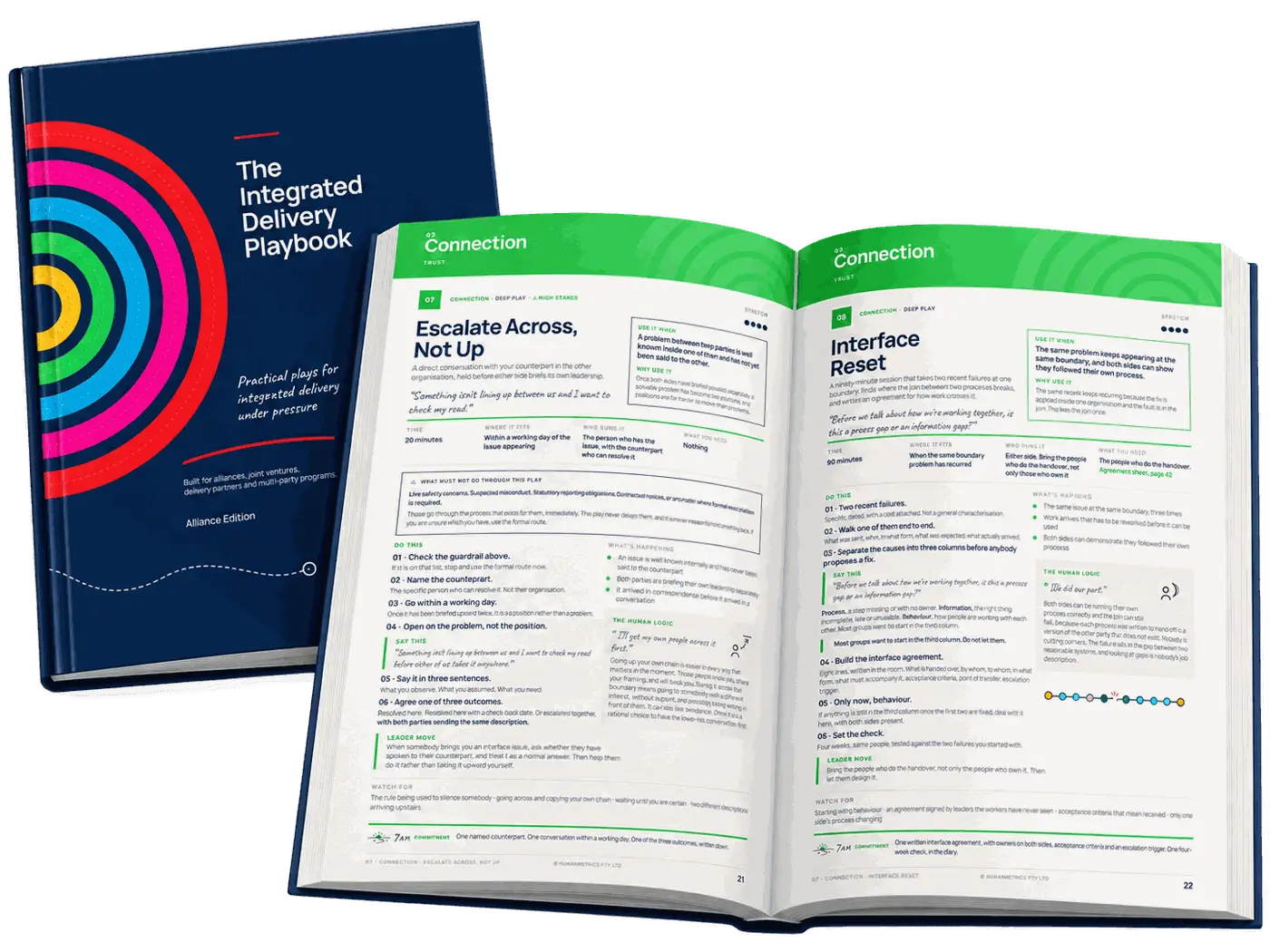
INTEGRATED DELIVERY
The hardest problems sit at the join.
Different employers. Different expertise. One shared result. We help owners choose the right delivery partner with behavioural assessment built into major procurements, then help the alliance mobilise and deliver as one team.
Our Integrated Delivery Playbook gives alliance leaders practical plays for mobilisation, handovers, escalation and the conversations in between.
ORGANISATIONS WE'VE WORKED WITH


LET'S SEE WHAT'S POSSIBLE
We overlook strengths in ourselves that everyone else spotted years ago.
Performance under pressure is not accidental. The conditions for it can be understood, measured and deliberately built.
Experienced practitioners in psychology, executive coaching, team development and organisational change.
Meet the practitioners behind the work